
Minuet in G Major
(BMV Ahn 114)
Minuet in G Major
Minuet in G Minor
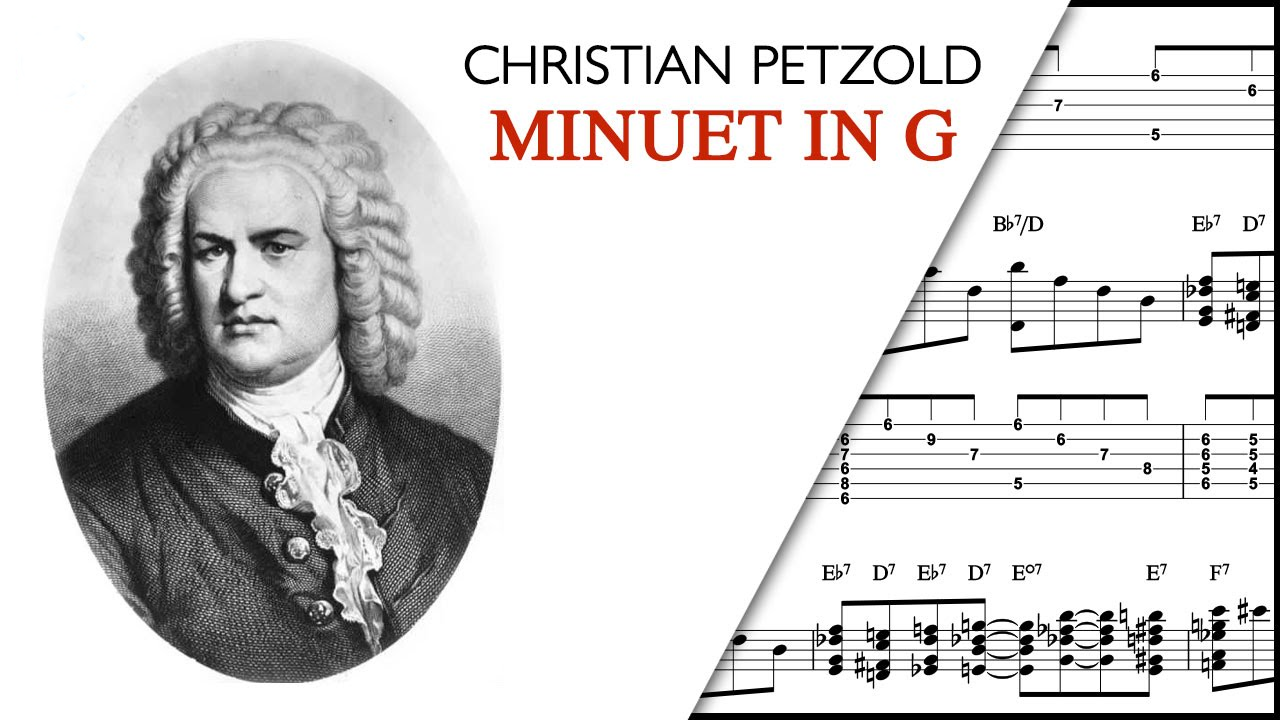
The Curious History of the Minuets in G Major and G Minor
From Johann Sebastian Bach to Christian Petzold
Few pieces of classical music have enjoyed such extraordinary popularity while simultaneously having such a confused history as the famous Minuet in G Major (BWV Anh. 114) and its companion Minuet in G Minor (BWV Anh. 115).
For over two hundred years virtually everyone—from music publishers to concert pianists, teachers and examination boards—believed these delightful little dances had been composed by Johann Sebastian Bach. They appeared in countless piano methods under his name and became among the first classical pieces learned by generations of piano students.
Today, however, musicologists are almost unanimous that neither minuet was written by Bach at all. The true composer was Christian Petzold, a respected German organist and composer who lived at exactly the same time as Bach.
So how did one composer receive credit for another man's music for nearly 250 years? The story is one of manuscripts, missing signatures, mistaken assumptions, and a remarkable piece of detective work.
Christian Petzold
Christian Petzold (1677–1733) was organist of the Sophienkirche in Dresden. Although relatively little of his music survives today, he was highly regarded during his lifetime and was considered one of the finest keyboard players in Germany.
Johann Sebastian Bach frequently visited Dresden to hear its famous musicians and to inspect the remarkable organs built by Gottfried Silbermann. It is therefore highly likely that Bach knew Petzold personally, or at the very least was familiar with his music.
The Notebook for Anna Magdalena Bach
The misunderstanding began with one of the most famous manuscripts in music history.
In 1725 Bach presented his second wife, Anna Magdalena, with a beautifully bound notebook. Today it is known as the Notebook for Anna Magdalena Bach, but it was never intended to be a collection solely of Bach's own compositions.
Instead, it functioned rather like a family music book. It contained:
- Works composed by Bach.
- Music copied from other composers.
- Keyboard exercises.
- Songs.
- Dance movements.
- Teaching pieces used by members of the Bach household.
Some entries were written by Bach himself. Others were copied by Anna Magdalena, and still others were added later by different hands.
Crucially, many of the shorter pieces—including the famous minuets—were copied without naming the composer.
Why Everyone Thought They Were by Bach
To modern readers it may seem surprising that anyone could make such a mistake, but the assumption was perfectly understandable.
The minuets appeared in Bach's own family notebook. No composer's name appeared beside them. Their elegant style resembled Bach's simpler keyboard teaching pieces, and for almost two centuries no earlier or alternative source was known.
Nineteenth-century editors therefore did what seemed obvious—they published the pieces as works by Johann Sebastian Bach.
Once the first respected editions did so, every subsequent publisher copied them. Music dictionaries repeated the attribution. Piano teachers repeated it. Examination boards repeated it.
Eventually the assumption became accepted as fact.
The works were even assigned catalogue numbers in the Bach-Werke-Verzeichnis:
- BWV Anh. 114 – Minuet in G Major
- BWV Anh. 115 – Minuet in G Minor
The letters "Anh." stand for Anhang ("Appendix"), a section reserved for doubtful or uncertain works.
The Missing Evidence
Meanwhile, another manuscript had been quietly sitting in Dresden for centuries.
This manuscript contained an entire keyboard suite by Christian Petzold. Within that suite appeared exactly the same Minuet in G Major immediately followed by the Minuet in G Minor.
Remarkably, scholars had known of this manuscript since the early twentieth century, yet nobody noticed that these were the very same pieces found in Anna Magdalena's notebook.
For over seventy years the connection simply went unnoticed.
The Discovery
Everything changed during the late 1970s.
German Bach scholar Hans-Joachim Schulze carefully examined the Dresden manuscript.
Unlike Anna Magdalena's notebook, this manuscript presented the minuets as part of a complete suite whose composer was already known—Christian Petzold.
The evidence was overwhelming.
Not only were the two minuets identical to those traditionally attributed to Bach, but they also formed a logical musical pair within Petzold's suite.
The suite presents the cheerful G major minuet, followed by its contrasting G minor companion, before returning to G major—a common Baroque dance structure.
In 1979 Schulze published his findings in the prestigious Bach-Jahrbuch. His research convincingly demonstrated that the famous minuets originated in Petzold's suite rather than with Bach.
Why Scholars Accepted the Change
Modern musicology relies on evidence rather than tradition.
Several independent facts all point towards Petzold:
- The complete suite survives under Petzold's name.
- The two minuets appear naturally within that suite.
- Anna Magdalena's notebook is known to contain works by many different composers.
- No manuscript written by Bach claims these works as his own.
Taken together, the evidence is regarded as decisive, and modern scholarly editions now credit Christian Petzold as the composer.
Why They Still Have BWV Numbers
Many people wonder why the pieces still carry Bach catalogue numbers if Bach did not compose them.
The answer is simply convenience.
For over a century musicians had referred to these works as BWV Anh. 114 and BWV Anh. 115. Rather than invent new catalogue numbers and create confusion, musicologists retained the familiar references while changing the attribution.
Why Many Books Still Say "Bach"
Many beginner piano books still print "Bach – Minuet in G."
Some publishers simply reproduce older editions. Others believe students recognise Bach's name more readily than Petzold's.
Many modern editions compromise by writing:
- Bach (Petzold)
- Formerly attributed to Bach
- Christian Petzold
Modern critical editions, however, now universally credit Petzold.
A Happy Ending for Petzold
Ironically, Christian Petzold's most famous compositions became world-famous only because generations of musicians believed they had been written by someone else.
Today the historical record has been corrected. The minuets remain exactly the same delightful works that generations of piano students have loved, but they are now appreciated as the work of a gifted Dresden composer whose contribution to Baroque keyboard music remained hidden in plain sight for more than two centuries.
It is a reminder that music history is still capable of surprises. Sometimes the greatest discoveries are not new masterpieces at all, but simply recognising who wrote the masterpieces we thought we already knew.
The Minuets in Modern Pop Culture:
Few pieces of classical music have had a greater impact on popular culture than the humble Minuet in G Major. Ironically, most people know the tune without having the slightest idea what it is called, who wrote it, or even that it is a classical work.
For more than a century it has been one of the very first pieces learned by beginning piano students (....and you can add me to the list). It has appeared in countless piano methods, examination syllabuses and children's music books across the world. Millions of pianists have played it, often within their first year of lessons, making it one of the most widely performed keyboard pieces ever written.
Its popularity extends far beyond the piano stool. Because the melody is simple, elegant and instantly recognisable, it has become musical shorthand for "classical music" in television, films and advertising. Whenever a director needs to suggest refinement, an old-fashioned music lesson, or a cultured drawing room, there is a good chance that someone is quietly playing the Minuet in G.
The tune has also become something of a musical cliché. Like Beethoven's Für Elise, Mozart's Eine kleine Nachtmusik, and Bach's Toccata and Fugue in D Minor, it is one of those melodies that people recognise immediately, even if they cannot name it.
Because it is technically accessible, the minuet has been arranged for almost every imaginable instrument. It has appeared in editions for violin, flute, recorder, guitar, cello, brass ensembles, school orchestras, music boxes, and even electronic keyboards with built-in teaching systems. It is frequently heard at school concerts and student recitals throughout the world.
The piece has also found its way into popular entertainment. It has appeared in cartoons, television programmes, documentaries and educational films, where it is often used simply because audiences instinctively associate it with learning music or with the elegance of the Baroque period. It even made an appearance (of sorts) in the 1965 No: 1 Hit by The Toys - it rached No: 1 in US Cashbox Chart, No: 2 on the US Billboard Hot 100 and others. It was a hit in the UK, the USA, Austalia, New Zealand and many other countries. Other versions were also recorded by artists such as: Cilla Black, The Supremes, The Delfonics, The Fleetwoods, The Lennon Sisters, Sarah Vaughan and many others.
Perhaps the greatest tribute to the tune's success is that it has become almost anonymous. Unlike many famous classical works, people often recognise the melody immediately while having no idea who composed it. For over two hundred years they would probably have answered, "Bach." Today the correct answer is Christian Petzold—but the music itself remains every bit as charming as when it was first written over three centuries ago.
The irony is delicious. Petzold spent more than 250 years watching, from the pages of history, while someone else received the applause for his most famous composition. Now that musicologists have restored the true authorship, he is finally beginning to receive the recognition he deserved all along. Yet the tune itself has lost none of its appeal. It remains one of the most beloved beginner piano pieces ever written and continues to introduce new generations of musicians to the joy of playing classical music.